My friend Sarah flew to Milan specifically to see The Last Supper. She’d been planning the trip for months, researching hotels near Santa Maria delle Grazie, mapping out the perfect day exploring Renaissance art. When she arrived at the museum ticket office, confident and excited, the staff member looked at her sympathetically and said: “Do you have a reservation?”
She didn’t.
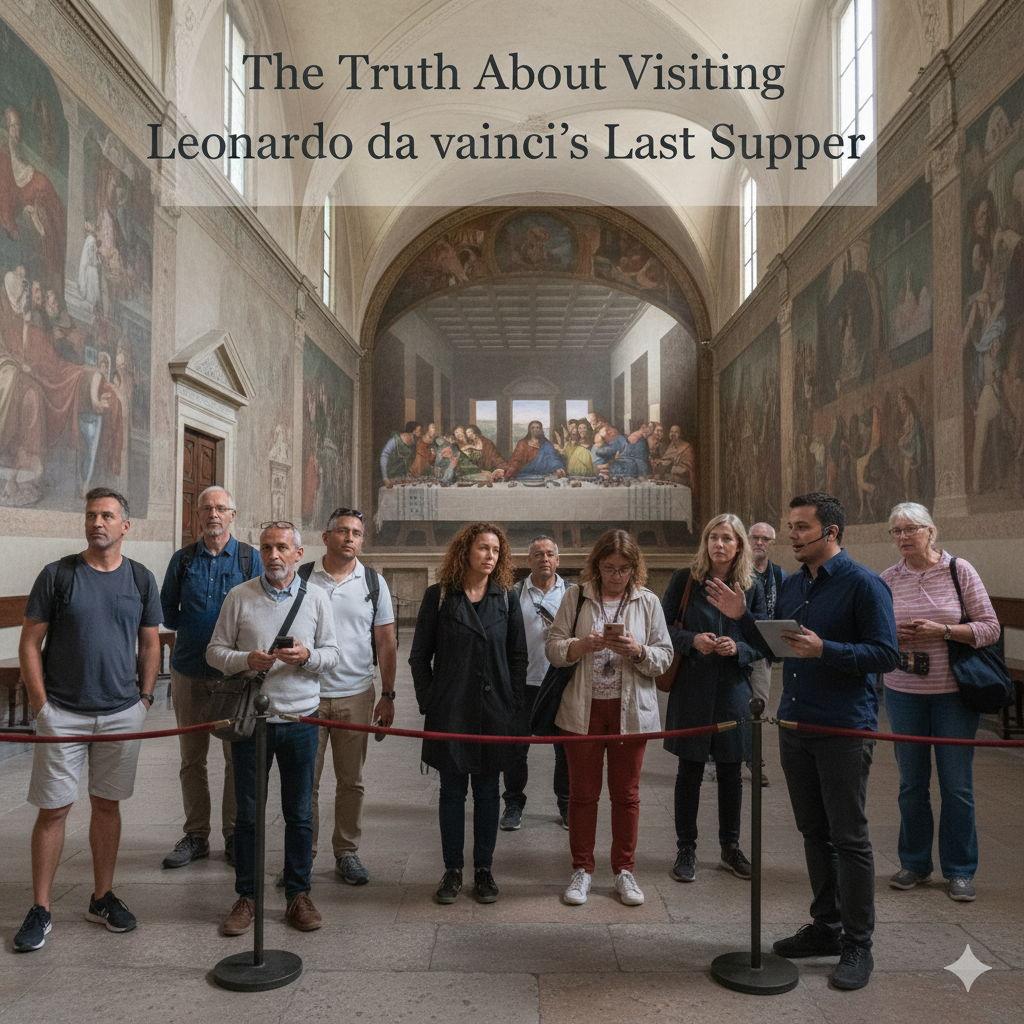
She left Milan two days later without seeing the painting. No amount of pleading, no willingness to pay triple the ticket price, no last-minute tour scrambling could get her inside that refectory. The painting she’d traveled across continents to witness remained just 500 meters from her hotel, completely inaccessible.
This isn’t a rare story. It happens every single day in Milan. Visitors show up assuming they can buy tickets on-site, only to discover that Leonardo da Vinci’s masterpiece operates under one of the strictest ticketing systems of any artwork in the world. Understanding why—and how to successfully see this painting—requires appreciating both what makes The Last Supper extraordinary and what makes it extraordinarily fragile.
A Moment Frozen in Paint
Between 1495 and 1498, Leonardo da Vinci transformed the north wall of the Dominican convent’s refectory into one of history’s most profound artistic achievements. The painting depicts the precise moment during Holy Thursday’s final meal when Jesus reveals to his twelve apostles that one among them will betray him before sunrise.
This wasn’t just another Last Supper painting. Da Vinci revolutionized how artists portrayed this biblical scene by focusing on the psychological explosion that followed Jesus’s devastating announcement. Instead of the traditional static arrangement with Judas isolated on the opposite side of the table, da Vinci captured raw human emotion in motion—shock, horror, denial, anger, confusion—all radiating outward from the serene figure of Christ at the painting’s calm center.
Every face tells a story. Philip points to himself, asking “Lord, is it I?” Thomas raises his finger skyward, foreshadowing his later doubt of the resurrection. Peter leans forward gripping a knife, presaging his violent reaction during Jesus’s arrest in Gethsemane. And Judas—unlike any previous depiction—sits among the group rather than apart, his face shrouded in shadow, one hand clutching a money bag containing thirty pieces of silver while his elbow tips over a salt cellar.
That spilled salt wasn’t accidental design. In Renaissance Italy, overturned salt signaled bad fortune and broken covenants. Da Vinci was creating visual puns and theological symbolism that scholars still decode today. The painting operates on multiple levels simultaneously: biblical narrative, psychological portrait, architectural marvel, and spiritual meditation.
Why Seeing It Requires Military-Level Planning
Here’s what makes The Last Supper different from virtually every other famous artwork: it’s not in a museum. It’s not on canvas that can be moved to climate-controlled galleries. It exists exactly where da Vinci painted it over 500 years ago, on the actual wall of the Santa Maria delle Grazie monastery refectory.
This creates profound preservation challenges. Da Vinci, ever the experimenter, didn’t use traditional fresco technique where paint is applied to wet plaster. Instead, he developed a experimental method using tempera and oil on dry wall, allowing him the time to create the extraordinary detail and subtle emotional expressions that make the painting remarkable. Unfortunately, this technique also made the painting incredibly fragile. It began deteriorating almost immediately.
The painting has survived remarkable trauma. Napoleon’s troops used the refectory as a stable. In 1943, Allied bombing destroyed much of the monastery, though miraculously the wall bearing The Last Supper remained standing amid the rubble. Multiple restoration attempts over centuries—some helpful, some damaging—have left the painting weathered but surviving.
Today, the room exists as a precisely controlled environment. Air quality, temperature, humidity, and light exposure are monitored constantly. The number of people entering, the duration of their stay, and the conditions they experience are strictly regulated to prevent any accelerated deterioration.
This is why only 40 visitors maximum are permitted inside the refectory for exactly 15 minutes per time slot. This is why advance reservations aren’t just recommended but mandatory. This is why tickets sell out months ahead. The painting’s survival depends on these restrictions.
The Ticket Reality: Numbers Don’t Lie
Let me break down the actual math that makes tickets so difficult to secure.
The museum operates Tuesday through Sunday, closed Mondays. Operating hours are approximately 8:15 AM to 7:00 PM. With 15-minute viewing slots and 40-person maximum capacity, that’s roughly 30 time slots per day, accommodating about 1,200 visitors daily.
Milan attracts millions of tourists annually. Even if only a small percentage attempt to see The Last Supper, demand vastly exceeds the 1,200 daily slots. Add to this equation the tour companies that bulk-purchase tickets months in advance, and you understand why individual ticket-seekers face such challenging odds.
Official tickets through the Museo del Cenacolo Vinciano cost €15 for full-price admission (with reduced rates for specific categories). Tickets are released in quarterly blocks. When the February-April 2026 quarter tickets went on sale December 17 at noon, the system was overwhelmed within minutes. Popular dates sold out almost instantly.
The official booking system limits purchases to 5 tickets maximum per transaction and 5 tickets per buyer per calendar year. Phone bookings allow up to 9 tickets. Groups of 10 or more must book via email, providing all participants’ names in advance. These restrictions exist to prevent scalping and hoarding, but they also mean individual travelers can’t simply “buy extras just in case.”
What Your Ticket Actually Includes
When you successfully secure tickets, you’re not just getting 15 minutes staring at a wall. The experience includes several components that make the brief viewing time more meaningful.
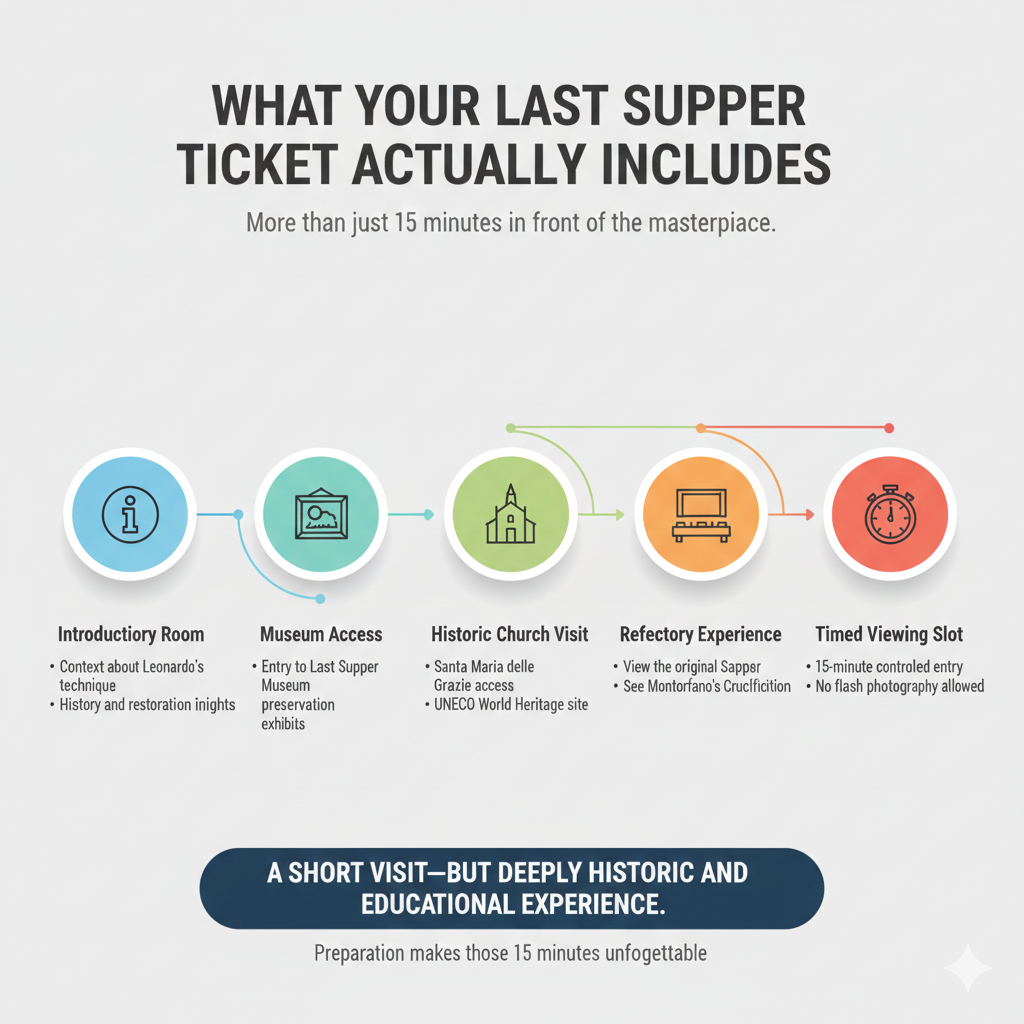
Before entering the refectory, you pass through a preliminary room with contextual information about the painting’s history, Leonardo’s techniques, and the restoration work that has preserved it. This preparation helps you know what to look for when you finally stand before the masterpiece.
Your ticket includes entry to the Last Supper Museum (Museo del Cenacolo Vinciano), which documents the painting’s creation, deterioration, and restoration. You can explore Santa Maria delle Grazie church itself, a stunning example of Renaissance architecture designed by Bramante. The church and monastery complex earned UNESCO World Heritage Site status in 1980 specifically because of The Last Supper’s presence and significance.
During your 15-minute viewing slot, you’re in the actual refectory where Dominican monks gathered for meals while the painting watched over them. On the opposite wall, you’ll see Giovanni Donato da Montorfano’s Crucifixion fresco from 1495, painted while Leonardo worked on The Last Supper. The contrast between traditional fresco technique and Leonardo’s experimental approach becomes immediately apparent.
Those 15 minutes pass incredibly quickly. Photography is permitted but flash is absolutely prohibited—staff monitor vigilantly. The lighting is deliberately low to protect the painting. You’ll want to study specific details: the perspective lines converging perfectly behind Christ’s head, the groupings of apostles in sets of three, the emotional expressions, Judas’s shadowed face, the spilled salt, Peter’s knife.
The constraint of limited time actually sharpens attention. You can’t casually glance and move on. Every second matters, creating an intensity of focus that enhances the experience.
The Alternative Path: Guided Tours and Their Trade-offs
When official tickets prove impossible to secure—which they often do—guided tours offer an alternative route. Tour operators maintain ticket allocations separate from individual purchase slots, meaning tours sometimes have availability when official tickets are sold out.
However, tours come with significant cost increases. Basic official tickets cost €15. Tours typically start around €50-75 and can climb to €150 or more depending on what’s included. Small group tours (limited to 6-15 people) command premium pricing but offer more personalized attention and better sightlines. Private tours for your party alone can exceed €200 per person.
What do you get for the higher investment? Skip-the-line access, which is valuable given that even ticket-holders face security checks and processing. Expert guides who explain the painting’s symbolism, point out details you’d miss independently, and provide historical context. Often tours combine The Last Supper with other Milan attractions like the Duomo, Sforza Castle, or La Scala opera house, creating an efficient full-day experience.
The trade-off is less autonomy. You’re on the guide’s schedule, following their narrative, viewing according to their pace. For travelers who’ve studied the painting extensively and want contemplative time alone with the artwork, guided tours feel rushed and structured. For first-time visitors wanting maximum understanding, expert guidance proves invaluable.
The Logistics Nobody Mentions Until You’re There
Assuming you’ve successfully obtained tickets, several practical details affect your actual visit.
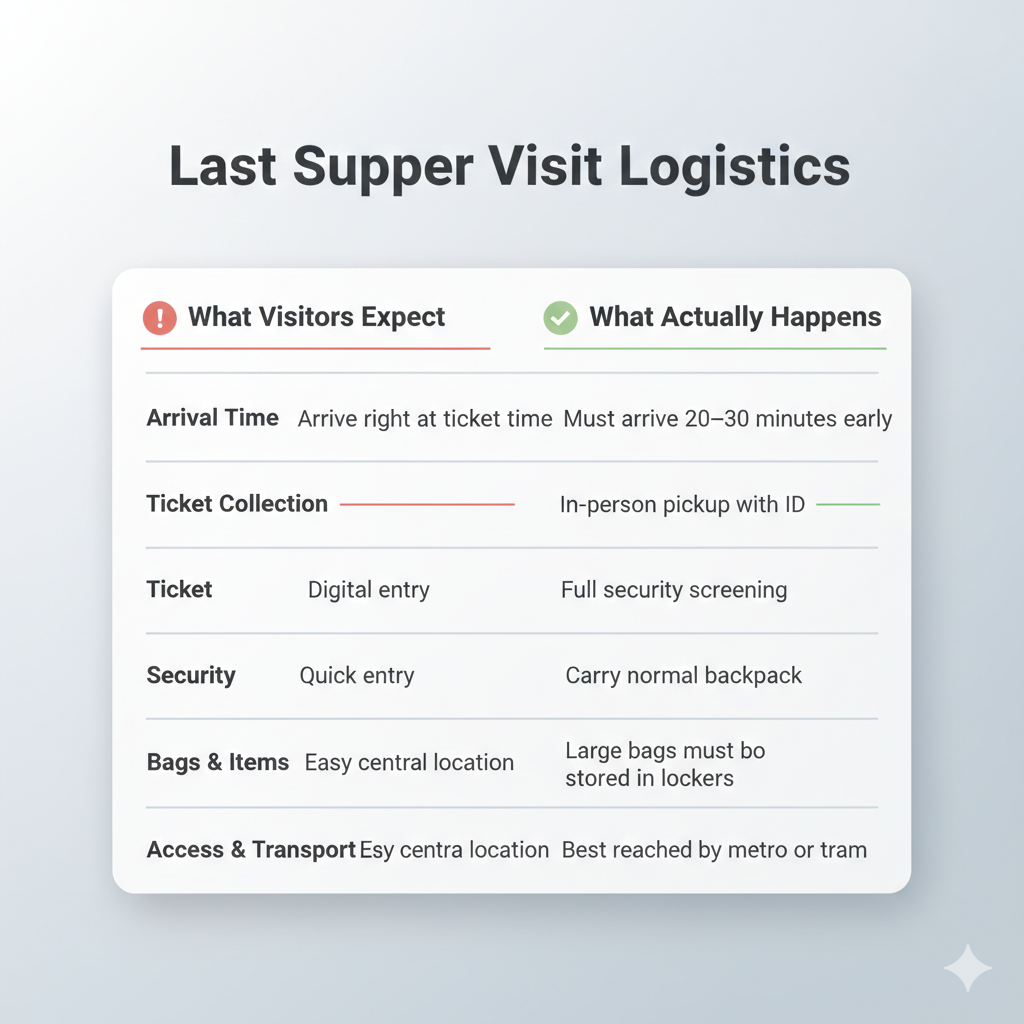
You must arrive at least 20-30 minutes before your scheduled time slot. This isn’t optional. Your ticket requires in-person collection from the Last Supper Museum Ticket Office in Piazza Santa Maria delle Grazie, just steps from the refectory entrance. You’ll need photo identification—passports, driver’s licenses, or photos of these documents on your phone typically suffice. They’re verifying you’re the actual ticket purchaser to prevent reselling.
Security screening is thorough. Metal detectors check all visitors. Large bags, backpacks, and bulky items aren’t permitted inside the viewing area. The museum offers timed lockers (€4.50 daily rate) in various sizes for storing belongings. Plan accordingly.
The dress code requires modest attire covering shoulders and knees—this is still a religious site. Flash photography is strictly banned and actively monitored. Pets aren’t allowed except service animals.
The location itself sits slightly west of Milan’s center along Corso Magenta. Public transportation provides easiest access: Metro Line 1 (red) stops at Cadorna or Conciliazione stations, both short walks away. Tram 16 stops directly at Santa Maria delle Grazie. The area falls within Milan’s Area C congestion charge zone, making driving less practical than public transit.
Arrive with realistic expectations about the painting’s condition. This isn’t a pristine, just-completed artwork. It’s weathered, faded, and shows centuries of deterioration despite restoration efforts. Original details visible in early copies like Giampietrino’s version (now at London’s Royal Academy) have vanished from the original. The bottom portion was damaged when a door was cut through the wall. What you’re seeing is a fragmentary, aged survivor that nonetheless retains extraordinary power.
Maximizing Your Fifteen Minutes
Given the strict time limit, strategic viewing makes the experience more rewarding.
Start with the overall composition. Leonardo organized the twelve apostles into four groups of three, arranged symmetrically around Christ’s central triangular form. The architectural perspective draws your eye directly to Christ’s head, where all the painting’s lines converge. The windows behind Christ frame him as the central figure, using light and space to emphasize his divine nature.
Move through the apostle groupings from left to right: Bartholomew, James the Lesser, and Andrew; then Peter, Judas, and John; then Thomas, James the Greater, and Philip; finally Matthew, Jude (Thaddeus), and Simon. Each face shows unique reaction to Jesus’s betrayal announcement. Each gesture contributes to the psychological drama.
Focus particularly on the Judas-Peter-John grouping immediately to Christ’s left. This is where da Vinci concentrated maximum symbolic detail. John leans toward Peter, who touches John’s shoulder while gripping a knife. Judas sits back in shadow, clutching his money bag, his arm overturning the salt cellar. The physical and moral geometry of this grouping rewards extended attention.
Study Christ’s hands. His right hand reaches toward bread while his left gestures outward in a accepting, explanatory motion. The serenity of his expression contrasts absolutely with the apostles’ agitation. While everyone else moves dynamically, Christ remains still—the calm eye of the emotional storm he’s created.
Look for details like the food on the table, the tablecloth’s blue-striped pattern (colors associated with Jewish tradition), the three lunettes above the painting showing the Sforza and Este family coats of arms (honoring the Duke who commissioned the work), and the contrast between this wall’s Christian narrative and the opposing wall’s Crucifixion scene.
The refectory itself deserves attention. This rectangular room with its decorative ceiling was designed as a communal dining space where The Last Supper would preside over actual meals—a meta-commentary on communion and breaking bread together. Understanding this original context enriches the artwork’s meaning.
Managing the Booking Challenge
So how do you actually obtain tickets? The most reliable approach combines multiple strategies executed patiently and persistently.
First, mark your calendar for quarterly ticket releases. Check the official Museo del Cenacolo Vinciano website (cenacolovinciano.org) for exact release dates and times. Set reminders. Be logged in, ready, and prepared to act the moment tickets become available. The system can be temperamental under heavy load, so have backup dates in mind beyond your ideal choice.
Second, check every Wednesday at noon. The museum occasionally releases additional tickets from cancellations, group reductions, or reserved allocations that didn’t sell. Wednesday noon has become known as the most likely time for these supplementary releases. It’s not guaranteed, but it’s worth checking regularly.
Third, consider less popular time slots. Early morning slots (8:15-9:00 AM) and late slots (6:00-7:00 PM) sometimes have better availability than midday times. Weekdays typically see lower demand than weekends. Winter months generally offer easier booking than spring and summer tourist high season.
When comparing various booking platforms and tour operators, you’ll likely receive confirmation emails and reservation communications from multiple sources. Managing these correspondence threads efficiently becomes important—especially when coordinating travel dates with booking availability across different providers.
Fifth, maintain flexibility. If your Milan dates are somewhat flexible, you dramatically increase your chances of securing tickets. Rigid date requirements make booking exponentially harder.
Sixth, if all else fails and you’re already in Milan, visit the ticket office in person. Very occasionally, last-minute cancellations create same-day availability. It’s unlikely but possible. More realistically, staff can advise on upcoming availability and alternative options.
The Strategic Approach That Actually Works
Here’s the methodology that maximizes your chances of successfully seeing The Last Supper:
Start planning months in advance, ideally 4-6 months before your intended travel dates. Mark your calendar for quarterly ticket releases and be prepared to book immediately when they open.
Build flexibility into your Milan itinerary. If you can visit across multiple possible dates, identify several acceptable time slots rather than fixating on one perfect day.
Monitor the official website religiously every Wednesday at noon for additional releases. Set calendar reminders so you don’t forget.
Research reputable tour operators as a backup option. Compare prices, read reviews, and identify 2-3 reliable companies you’d trust if individual tickets prove impossible.
If tickets remain elusive as your travel dates approach, book a tour rather than gambling on last-minute availability. The premium cost is less painful than missing the painting entirely.
When booking anything—tickets or tours—provide accurate identification information. Name mismatches can cause problems collecting tickets.
Plan the rest of your Milan day around your Last Supper time slot, not the reverse. This painting dictates your schedule; everything else adjusts accordingly.
The Bigger Picture: What The Last Supper Teaches About Travel
Sarah’s failed attempt to see The Last Supper taught her something valuable that applies far beyond one painting in Milan. Some experiences can’t be improvised. Some destinations reward planning over spontaneity. Some treasures require commitment, patience, and strategic thinking to access.
This isn’t about being less adventurous or more rigid. It’s about matching your approach to the specific requirements of what you’re trying to experience. Wandering randomly through Rome’s streets discovering unexpected piazzas? Perfect for spontaneity. Seeing one of history’s most protected and fragile artworks? Requires advance planning.
The Last Supper’s restricted access also creates unexpected value. Because seeing it requires effort, the experience becomes more meaningful. You’ve invested time, planning, and persistence. When you finally stand in that refectory, you’re not casually checking something off a list. You’re fully present, completely attentive, grateful for the opportunity.
The painting itself depicts a moment of truth—when comfortable assumptions shatter and people confront unexpected betrayal. Perhaps there’s fitting symbolism in the fact that seeing this painting requires confronting your own assumptions about travel, planning, and accessibility. The reward matches the challenge.
Milan offers extraordinary experiences beyond The Last Supper: the Gothic magnificence of the Duomo, the fashion and design culture, the Sforza Castle’s art collections, the hidden gem of San Maurizio al Monastero Maggiore with its extraordinary frescoes, the vibrant aperitivo culture. But for many visitors, Leonardo’s fragile masterpiece represents Milan’s most compelling draw—the one unmissable experience that justifies the entire journey.
Just make sure you have a reservation.